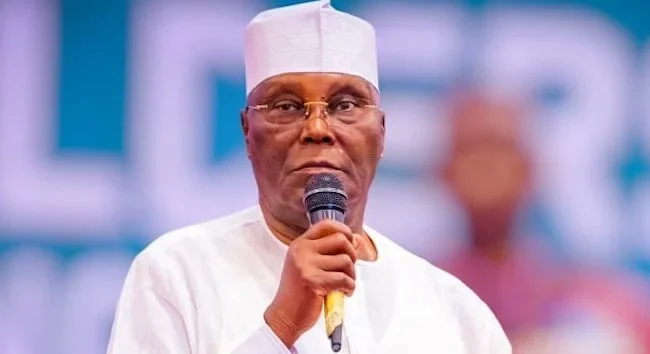
Former Vice President and 2023 presidential candidate Atiku Abubakar has responded to the news that his son, Abba Abubakar, has defected from the Peoples Democratic Party (PDP) to the All Progressives Congress (APC) and pledged support for President Bola Tinubu’s re-election bid in the 2027 general elections. Atiku described his son’s political decision as entirely personal, emphasising his respect for individual choice in a democratic society.
Abba’s defection, publicly announced on January 15, 2026, was marked by his reception into the APC at the National Assembly Complex in Abuja, where he pledged to help mobilise support for Tinubu’s second-term campaign.
What Abba Abubakar Did
Abba Abubakar — a political activist and founder of the Haske Atiku Organisation in 2022 — formally left the PDP and joined the APC in a ceremony attended by key party leaders, including Senator Barau Jibrin, Deputy President of the Senate.
At the event, he publicly aligned with the APC’s Renewed Hope Agenda and directed members of his former movement to support President Tinubu’s re-election bid in 2027. He also renamed his organisation to the Haske Bola Tinubu Organisation to reflect the new political alignment.
Atiku’s Reaction: “Entirely Personal”
In response to his son’s defection, Atiku Abubakar took to social media — notably his X (formerly Twitter) account — to clarify his position. He stressed that:
“The decision of my son, Abba Abubakar, to join the APC is entirely personal. In a democracy, such choices are neither unusual nor alarming, even when family and politics intersect.”
Atiku, now a member of the African Democratic Congress (ADC) — the party he joined after leaving the PDP — reiterated that he does not coerce his children in matters of conscience and extended that principle to all Nigerians.
Political Context of the Defection
The son’s move has wider political implications beyond the personal realm. It comes as the APC seeks to consolidate support ahead of the 2027 general election, while Atiku and his allied opposition forces — including the ADC — position themselves as challengers to the ruling party and its policies.
Abba’s switch is viewed by APC leaders as a strategic gain, though critics argue it may also signify a generational and ideological divergence within the broader opposition landscape.
Atiku’s Continued Criticism of APC
Despite acknowledging his son’s freedom to choose, Atiku did not shy away from criticising the APC’s record in office. In his statement, he highlighted concerns about:
- poor governance under the APC, and
- economic and social hardships faced by Nigerians during the party’s tenure.
He reiterated his commitment to working with opposition allies to provide Nigerians with “a credible alternative that brings relief, hope, and progress.”
Reactions Across the Political Spectrum
Reactions to the defection and Atiku’s calm response have been mixed:
- Some APC figures celebrated Abba’s decision as a symbolic boost ahead of 2027.
- Critics, including opposition supporters, framed the defection as politically significant but not necessarily reflective of broader public sentiment.
- The Lagos State APC went further by mocking Atiku’s credibility, arguing that his son’s departure signals a rejection of his political judgment by those closest to him.
Leave a Reply